Petal Politics: How Gen Z Is Using the Victorian Language of Flowers to Say the Unsayable
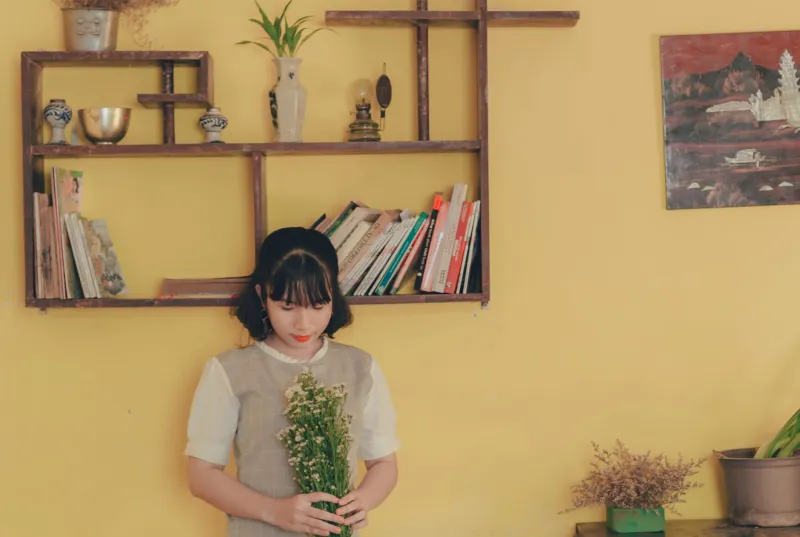
At a protest in Washington D.C. last spring, among the handmade signs and chanted slogans, a small group of demonstrators carried something quieter: bouquets. Carefully, deliberately composed bouquets. Yellow carnations for disdain. Lavender for distrust. Marigolds for grief. Rue tucked into every arrangement like a signature.
If you didn't know what you were looking at, you saw flowers. If you did, you saw a full political statement, assembled petal by petal.
Floriography—the coded language of flowers that peaked in Victorian England and America, where social norms made direct expression dangerous—is back. And the people bringing it back are in their twenties, furious, creative, and very much done waiting for a platform to give them permission to speak.
A Language Older Than the Feed
The Victorians didn't invent flower symbolism—humans have been assigning meaning to plants for thousands of years across dozens of cultures—but they systematized it. Floral dictionaries published in the 1800s gave specific meanings to hundreds of flowers, allowing people to communicate feelings that polite society forbade them to say aloud. A bouquet handed across a parlor could declare love, signal refusal, or deliver an insult with complete plausible deniability.
The parallel to contemporary digital life isn't lost on the people reviving it.
"I can't say certain things on certain platforms without getting flagged or shadowbanned," says Cass, 23, a queer activist and floral artist based in Atlanta. "But I can hand someone a bundle of flowers. Nobody's going to moderate that. Nobody's going to remove it from the timeline."
Cass has been studying historical floral dictionaries for two years and now composes what she calls "political arrangements"—bouquets built around specific messages she wants to deliver at events, protests, or community gatherings. She's also been teaching small workshops, passing printed reference cards to participants, building a local vocabulary that operates entirely outside any digital space.
Flowers as Encryption
The appeal of floriography to this generation isn't purely political. For many practitioners, it's also deeply personal—a way of communicating emotional complexity that social media's flat, performative architecture genuinely cannot hold.
"There are things I feel that don't have a caption," says Jordan, 26, a florist and community organizer in Brooklyn who started incorporating symbolic arrangements into their work after a friend introduced them to a Victorian floral dictionary found at a stall in the Brooklyn Flea. "Grief that's also gratitude. Love that's also anger. The algorithm wants simple emotions. Flowers can hold contradictions."
Jordan has started offering what they call "message bouquets" to clients who want to send something that goes beyond 'thinking of you.' A customer recently commissioned an arrangement for a friend navigating a difficult family estrangement: rosemary for remembrance, white chrysanthemum for truth, a single red poppy for consolation. No card. No caption. Just the flowers, doing the work.
"She cried when she got them," Jordan says. "And she knew exactly what they meant. That's communication. That's more than most text messages accomplish."
The Printed Dictionary as Community Object
Like so many of the unconventional subcultures blooming right now, this one runs on paper. Reprinted Victorian floral dictionaries, annotated zines, hand-illustrated reference cards, and collectively authored guides are circulating through friend groups, feminist collectives, queer communities, and activist networks from Seattle to Miami.
Some groups are writing their own updated dictionaries—expanding the Victorian vocabulary to include plants with contemporary significance, assigning meanings to native wildflowers that the original English guides never included, and incorporating symbolism from non-European botanical traditions that Victorian floriography largely ignored.
A collective in New Mexico called Lengua Verde (Green Tongue) has been working for the past eighteen months on a floral dictionary that centers Indigenous Southwestern plant knowledge alongside Victorian symbolism. The result, distributed as a limited-run printed booklet, is a genuinely hybrid document—a flower language that holds multiple histories at once.
"The Victorian dictionaries were written by and for a very specific kind of person," says Ana, one of Lengua Verde's founding members. "We wanted a language that actually reflected who we are and where we are. The flowers growing outside our windows deserved meanings too."
Protest in Petals
The use of floriography in activist contexts is perhaps the most striking dimension of the revival. Flowers have long been present at protests—think of the iconic images of carnations placed in rifle barrels during Vietnam-era demonstrations—but this new practice is more intentional, more encoded, more specific.
Groups are coordinating arrangements for demonstrations in advance, agreeing on a shared vocabulary so that participants carrying different bouquets are collectively spelling out a statement. Photographs of these arrangements circulate in community spaces with no explanation—meaningful to those who know the code, invisible as protest to those who don't.
"There's something powerful about a message that only certain people can read," says Cass. "It creates community. It says: you belong to something. You know something."
There's also a durability to it that digital communication lacks. A screenshot can be removed. A tweet can be deleted. But a pressed flower tucked into a letter, a sprig of rosemary left on a doorstep, a wreath hung on a community bulletin board—these things persist. They exist in physical space. They decay on their own terms.
What the Flowers Are Actually Saying
Spend enough time in these communities and you start to hear a consistent message underneath all the specific arrangements and encoded bouquets. It's not just about the flowers. It's about reclaiming the right to speak in ways that can't be surveilled, monetized, or moderated.
In a media landscape where expression is constantly being shaped by what the algorithm rewards and what the platform allows, flower language offers something genuinely radical: a communication system that predates the internet by centuries and will outlast every app currently on your phone.
"I think people are hungry for ways to say things that feel real," Jordan says, trimming the stems on a new arrangement while they talk. "Not optimized. Not branded. Just real."
They hold up a finished bouquet: deep purple lavender, a handful of rue, one bright sprig of rosemary.
Distrust. Regret. Remembrance.
Or maybe, read another way: I see what happened. I haven't forgotten. I'm still here.
The flowers don't care which reading you choose. They just keep meaning what they mean.