Sealed With Intention: Why Gen Z Is Falling Hard for the Lost Art of the Letter
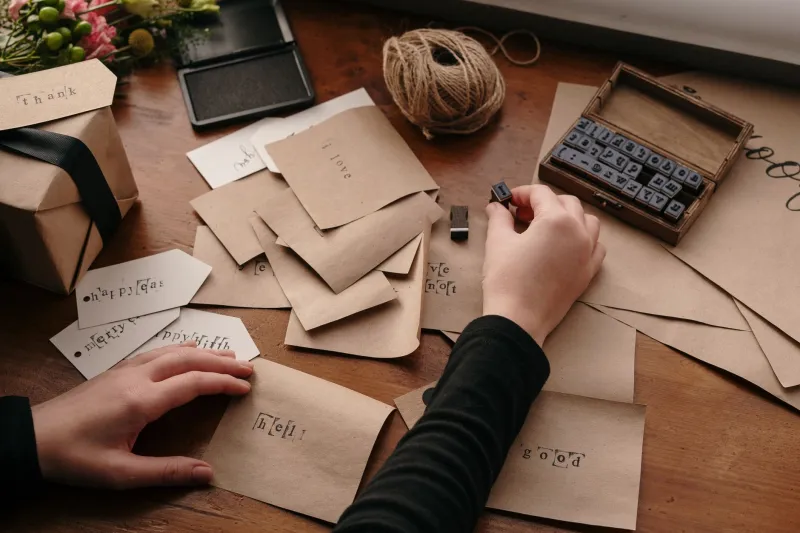
Somewhere in Portland, Oregon, a 24-year-old named Desi is sitting cross-legged on her apartment floor surrounded by washi tape, vintage postage stamps, and a stack of envelopes she's been decorating since noon. She's not making a craft project for Etsy. She's writing to eight people she's never met in person — people she found through an online pen pal matching community called Slowly, which deliberately delays messages to mimic the pace of real mail. Tonight, though, she's doing it the real way. Ink, paper, stamp, mailbox.
"There's something about knowing someone is going to physically hold this thing I made," she says. "It changes how I write. It changes what I'm willing to say."
Desi is not an anomaly. Across the US, a quiet but surprisingly organized movement of Gen Z writers, artists, and burnout survivors is rediscovering handwritten correspondence — not as nostalgia cosplay, but as a legitimate form of resistance and connection in a world that increasingly monetizes every tap and scroll.
From DMs to Decorated Envelopes
The pen pal revival didn't come out of nowhere. It gained real traction during the pandemic, when people were starved for tangible proof that other humans existed beyond a screen. But what started as a coping mechanism has evolved into something more intentional and, honestly, more radical.
Subreddits like r/penpals and r/snailmail have hundreds of thousands of members. Instagram accounts dedicated to "mail art" — letters transformed into miniature collages, paintings, and hand-lettered masterpieces — pull serious engagement. There are Discord servers where people coordinate letter-writing nights the same way others coordinate gaming sessions. Some participants send decorated envelopes stuffed with pressed flowers, original poetry, handmade stickers, and micro-zines. Others keep it simple: a few pages of honest, unedited thought that would never survive the edit-before-you-send culture of texting.
What ties all of it together is the deliberate slowness. You write. You wait. You receive. You sit with it.
Your Brain on Snail Mail
Neuroscience has a lot to say about why this feels so different from digital communication, and none of it is particularly flattering toward your phone.
Handwriting activates regions of the brain associated with memory formation, fine motor control, and emotional processing in ways that typing simply doesn't replicate. Studies from the University of Washington and others have shown that students who take notes by hand retain information more deeply than those who type — not because they're old-fashioned, but because the physical act of forming letters forces the brain to synthesize rather than transcribe.
Apply that to personal communication and the implications get interesting fast. When you write a letter by hand, you can't copy-paste, you can't unsend, and you can't flood the conversation with fifteen rapid-fire messages that collectively add up to one coherent thought. You have to decide what you actually mean before the pen hits the paper. That friction — which digital design has spent decades trying to eliminate — turns out to be kind of the whole point.
"Friction is where the thinking happens," says Marcus, a 27-year-old in Chicago who started writing letters during a particularly brutal stretch of social media fatigue. "When I text, I'm reacting. When I write a letter, I'm actually processing."
Surveillance Capitalism Doesn't Read Your Mail
There's another layer here that goes beyond brain chemistry, and Gen Z — a generation that grew up being the product — is acutely aware of it.
Every email you send is parsed. Every text on a major platform is, at minimum, metadata for someone's ad targeting model. Your communication history is a commodity, and most of us have quietly accepted that as the cost of staying connected. The pen pal community hasn't.
"I think about who owns my words a lot," says Rae, a 22-year-old from Atlanta who runs a small mail art exchange through her local zine library. "When I write a letter, literally only the person I sent it to has it. That feels insane in the best possible way."
This isn't tinfoil-hat territory — it's a considered choice, and it's one that resonates particularly hard with younger people who came of age watching privacy erode in real time. Physical mail, protected by federal law in a way digital communication simply is not, offers something that feels almost quaint: actual privacy.
For many in the pen pal community, that's not a side benefit. It's the whole pitch.
The Art of the Envelope
One thing that separates this revival from your grandma's pen pal club is the sheer visual ambition of it. Mail art has a legitimate avant-garde history — the Fluxus movement in the 1960s used postal systems as a distribution network for radical art — and today's practitioners are drawing on that lineage whether they know it or not.
People are spending real time on their envelopes. Watercolor washes, rubber stamp compositions, hand-lettered addresses in calligraphy styles that took months to learn. Some participants treat the envelope itself as the art piece and the letter inside as the caption. Others include tiny handmade books, folded origami inserts, or packets of seeds from their gardens.
The labor involved is the statement. In an economy where content is produced at industrial scale and distributed at zero marginal cost, something that took three hours to make and costs a dollar to send carries a completely different kind of weight.
"I got a letter last month that had a tiny watercolor of my city's skyline on the back flap," says Priya, a 25-year-old in Minneapolis. "The person had looked up my city and painted it. I cried. I don't think I've ever cried at a text message."
Slow Communication as Radical Self-Care
Mental health professionals are starting to pay attention. Therapists who work with anxious young adults are increasingly pointing to the pen pal practice as a form of what they call "intentional communication" — a way of building genuine intimacy without the dopamine loop of instant feedback.
The wait between letters forces a kind of emotional patience that most digital communication has trained us out of. You send something vulnerable and then you sit with it for days or weeks before you hear back. That's not a bug. For a lot of people, it turns out to be the feature.
For Desi, still on her floor in Portland, surrounded by stamps and tape and half-finished letters, the whole thing is simpler than any of the theory.
"I feel like myself when I write letters," she says. "Not a version of myself I'm performing for an algorithm. Just me, on paper, talking to another person."
In 2025, that might be the most countercultural thing you can do.