Roots Before Algorithms: The Young Herbalists Building Wellness Communities You Can't Google
Somewhere in Portland, Oregon, a 24-year-old named Wren is photocopying a forty-page plant identification guide in the back of a copy shop. She'll fold the pages herself, staple the spine by hand, and distribute them at a foraging walk next Saturday—cash only, location shared by text chain, no social media posts, no event pages. By the time you read this, you probably still won't be able to find her.
That's entirely the point.
Across the country, a loose, deliberately unmapped network of young herbalists is quietly building something that looks nothing like modern wellness culture. No influencer partnerships. No supplement storefronts. No algorithm-friendly aesthetic. Just plants, paper, and people who show up.
The Friction Is the Feature
Ask anyone inside these communities why they avoid digital platforms and you'll get variations on the same answer: the friction is what makes the knowledge real.
"If you can just search for something and get a TikTok about it, you don't actually learn it," says Dayo, a 26-year-old herbalist based outside of Asheville, North Carolina, who runs what she calls a "plant circle"—a rotating group of about fifteen people who meet monthly to share foraged materials, printed recipes, and handmade tinctures. "When you have to show up somewhere, look someone in the eye, and ask them to teach you, you remember it. You earn it a little."
This intentional resistance to convenience isn't anti-technology for its own sake. It's a considered response to what many of these young practitioners see as a fundamental problem with how wellness gets packaged and sold online—where misinformation spreads as fast as legitimate knowledge, and where the line between community and commerce collapses almost immediately.
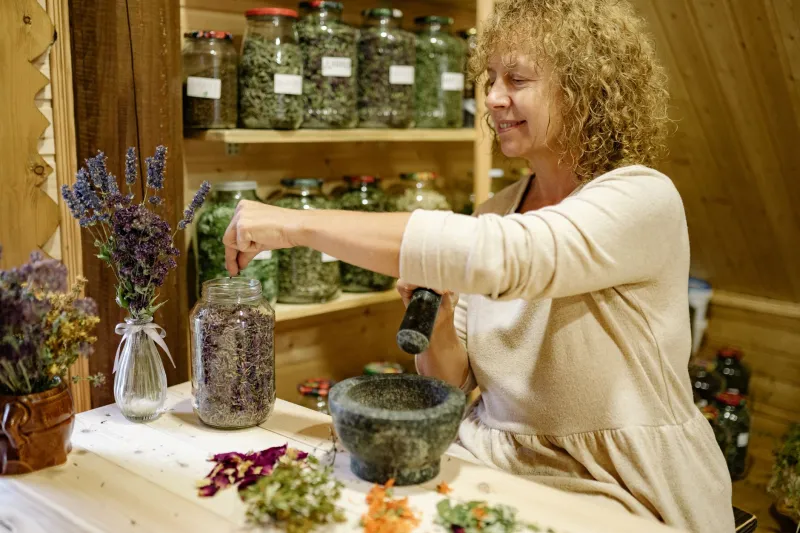
Printed guides, hand-drawn botanical illustrations, and zine-style remedy booklets are the primary currency of these networks. They get passed between members, annotated, corrected, updated in pen. The imperfection is part of the value.
Foraging as Political Act
It would be easy to read this movement as pure aesthetics—another Gen Z reclamation project dressed in linen and dried lavender. But spend any time in these communities and a sharper edge emerges.
Many participants frame their practice explicitly as resistance. Resistance to the pharmaceutical industry, to the commodification of Indigenous plant knowledge, and to the surveillance economy that monetizes every health search you've ever made. Learning to identify elderflower or make a mullein tea isn't just a wellness choice—it's a small act of self-determination.
"I grew up watching my grandmother use plants she'd learned from her grandmother," says Marcus, 27, who leads foraging walks in the Chicago metro area. "That knowledge almost died in my family. Reclaiming it feels like reclaiming something that was taken, not just discovered."
His walks are free, listed nowhere publicly, and found only through community referral. Participants bring notebooks. Phones stay in pockets. He's deliberate about that.
"The moment someone starts filming, the whole dynamic shifts. People start performing instead of learning. I'm not interested in content. I'm interested in competence."
The Printed Underground
The physical materials circulating through these networks are genuinely beautiful objects. Risograph-printed herb guides with hand-lettered Latin names. Folded remedy cards tucked inside seed packets. Seasonal newsletters mailed to members who've been vetted through personal referral.
In Brooklyn, a collective called Thornwork produces a quarterly printed guide covering regional plant identification, folk remedy history, and community foraging ethics. It's not sold anywhere online. Copies circulate through a network of about two hundred people across the Northeast, passed hand to hand or mailed to vetted contacts. The waiting list to receive it runs months long.
"We thought about doing a website," admits one of the collective's founders, who asked to be identified only as Lena. "But as soon as you put something online, you lose control of how it's used and who's using it. We want accountability. We want to know who's in the room."
That accountability cuts both ways. These networks take accuracy seriously in ways that online wellness culture often doesn't. Incorrect plant identifications get corrected publicly within the group. Remedy claims are sourced and debated. There's a rigor here that the algorithm has no incentive to reward.
What Gets Lost, What Gets Found
Not everything about operating offline is easy or romantic. These networks are, by design, hard to access—which raises real questions about who gets in and who gets left out. Several practitioners acknowledged this tension directly.
"I think about accessibility a lot," says Dayo. "I don't want this to become a thing only certain kinds of people can find. That would be a failure." Her plant circle has been working to expand through community health centers and mutual aid networks, trying to build bridges that don't require existing social capital to cross.
There's also the question of sustainability. Word-of-mouth networks are slow. They depend on trust that takes time to build and can collapse quickly. Several practitioners described watching smaller circles dissolve after a single conflict or a key member moving away.
But for those who stay in it, the rewards seem to go beyond the plants themselves. What these communities are really growing, it turns out, is something rarer and harder to source than any herb: actual human trust.
"I know the people in my circle," Marcus says. "I know their names, their families, what they're dealing with. That's not something you get from a wellness app. That's something you build over years." He pauses, then adds: "And you can't screenshot it."